AI Website Builder or Custom Development: A Practical Guide for Businesses Looking to Transform their Online Presence
AI website builders can launch your site before your coffee cools – but will it still pull its weight when your business gets serious? Here’s how to tell when speedy is enough, where custom development really earns its keep, and which choice could quietly cost you more.
-
 By
Anjna Raj
|
By
Anjna Raj
|
- • 18 min Read
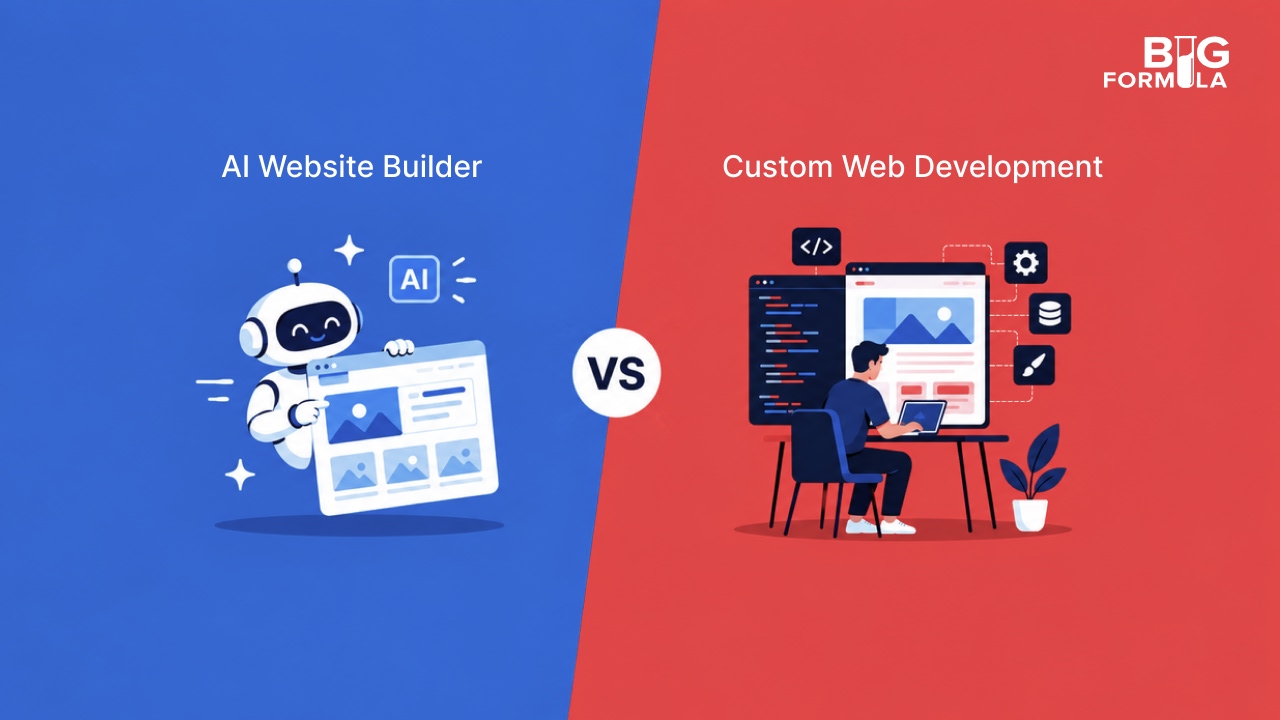
A founder comparing a pocket-friendly AI website generator against a pricier custom development quote is really asking two questions at once, though it feels like one. The first is which option gets a website live, faster and cheaper. The second, quieter question is which one will do more for the business over the next three years. Most comparisons collapse these into a single verdict, cheap and fast against expensive and better, when the honest answer depends on what the website is for. A landing page validating a new product idea carries different demands than a website carrying the entire conversion journey of an established brand. What matters is matching the build method to the job at hand.
What Actually Separates an AI Builder from Custom Development?
An AI website builder assembles a site from a finite library of templates, blocks and layout patterns, then uses a language model to fill those structures with content drawn from a prompt or a business’s existing information. Platforms such as Wix, Squarespace, Framer and Hostinger’s AI tools all work this way: the underlying architecture is shared across every site the platform generates, and what changes is the copy, imagery and colour scheme layered on top.
Custom website development starts from the opposite direction. A developer or design team builds the information architecture, interaction design and technical stack around one business’s audience, offering and conversion goals, with no obligation to fit a pre-existing template. Where AI Builders trade specificity for speed; custom development trades speed for a site shaped entirely around how one business actually sells.
Where Do AI Website Builders Genuinely Earn Their Keep?
AI builders have become the default starting point for many businesses because they extend a shift the web had already made. Across the internet, 31.5% of websites use none of the content management systems tracked by W3Techs, while WordPress accounts for 40.2%, Shopify for 5.4%, Wix for 4.2% and Squarespace for 2.4%, according to W3Techs’ September 2026 survey. The figures illustrate how extensively the web already relies on platforms that abstract away much of the underlying development work – well before AI entered the picture. In the European Union, 79.02% of enterprises reported having a website in 2025, a slight increase on 2023, according to Eurostat’s e-business integration statistics, with ownership ranging from 76.67% among small enterprises to 95.65% among large ones.
The AI-specific segment of that market is growing fastest of all. The global market for AI-powered website builders is projected to grow from $2.69 billion in 2025 to $3.24 billion in 2026, reaching $17.43 billion by 2035 at a compound annual growth rate of 20.55%, according to Precedence Research, with small and medium enterprises accounting for close to half of that revenue. US business adoption of AI tools has followed a comparable curve: the Census Bureau’s Business Trends and Outlook Survey measured AI use in a core business function at 19.8% of firms as of May 2026. For a business testing a new offer or needing a functioning site by next week, that combination of low cost, short timeline and reasonable design floor is difficult to argue with.
Where Does the Same Speed Become an Obstacle?
That obstacle shows up first in performance and conversion data. Forrester research has estimated that better user experience can increase website conversion rates by up to 400% – a figure that illustrates the commercial value of getting the underlying experience right. In practice, that means navigation built around how a specific audience searches, layouts sequenced around a defined buying journey, and load-time optimisation tuned to the page’s actual content. Templated builders are optimised for the median site on their platform, not the specific one running it. HTTP Archive’s Web Almanac dataset found that only 48% of mobile websites delivered good Core Web Vitals scores in 2025 – a gap that tends to widen on heavily templated sites, where every added block carries its own script weight.
The same pattern shows up in brand perception. AI-generated and templated sites draw on the same pool of popular layouts, so websites across unrelated industries increasingly converge on similar hero sections, card grids and typography choices. For a business competing on price, that sameness is a minor cosmetic issue. For one competing on trust or a specific brand promise, looking indistinguishable from a competitor’s AI-built site works directly against the sale.
Why Does Custom Website Development Weigh More for Conversion-Critical Businesses?
Custom website development earns its higher upfront cost precisely where an AI builder’s genericism becomes a liability. Businesses whose website is the primary conversion engine rather than a digital business card simply cannot afford the reputational burn a generic site would cost them, even if it came cheap. A law firm converting visitors into consultations, a fintech onboarding new accounts, or a B2B vendor walking a buyer through a multi-step evaluation, all need an information architecture built around how their specific audience decides, not a template designed to serve every business equally. A custom site is built around one brand’s positioning, one audience’s objections and one conversion journey, while a templated site is optimised for the average visitor to the average business on that platform.
The practical differences compound. A custom build gives a development team full control over page speed, structured data and Core Web Vitals, rather than inheriting whatever performance ceiling the platform allows. It also removes the constraint of a pre-built component library, which matters for businesses that need bespoke booking flows or industry-specific integrations a general-purpose builder was never designed to hold. The result is a website built as a structured route from first visit to signed customer, rather than a container for content.
How Should a Business Actually Decide?
Rather than treating AI builders and custom development as competing philosophies, the choice is better framed as a function of three variables:
- Does the website drive revenue directly?
- Is the audience’s decision-making process specific?
- How long will the site remain in service?
A pre-revenue business validating an idea, a nonprofit publishing an informational page, or a team that needs something live within days has little reason to start with custom development. The calculation shifts once a website carries real commercial weight: when visitors compare the business against named competitors, when the buying decision involves several stakeholders, or when the site needs to reflect a brand already built through other channels. In those cases, the cost of a generic, slower-loading website tends to outweigh the savings from a builder subscription within months, let alone years!
Is There a Middle Path?
None of this requires an all-or-nothing choice at the outset. Many businesses reasonably launch on an AI builder to test a market, then commission custom development once traffic, conversion data and brand identity are established enough to brief a design team properly. The sequencing matters more than the starting point: businesses that treat an AI-built site as a permanent fixture, long after it stops matching the brand or the buying journey, are the ones most likely to lose ground to competitors who made the investment. The website is rarely the most expensive part of running a business, but for many it is the most visited, which makes the decision worth revisiting deliberately rather than by default.
Frequently Asked Questions
Does moving from an AI website builder to custom development affect search rankings?
The risk sits in the mechanics of migration rather than in custom development itself: every URL and metadata field on the old site needs a mapped equivalent on the new one, with redirects in place before the switch goes live, or search engines treat the new site as unrelated and rankings reset rather than transfer. Monitoring indexing through Google Search Console in the weeks after launch catches gaps before they cost meaningful traffic.
How long does a custom-built business website typically take to launch?
Beyond the build itself, most of the calendar time goes into work an AI builder skips entirely: the process of discovery that involves agreeing the site’s structure and goals, content and asset collection from the client, and a testing round across browsers and devices before launch. Businesses that budget only for the build, treating it as the sole variable, are usually the ones whose launch date slips.
Is an AI-built website ever the wrong choice, even at the earliest stage?
Yes, where the website carries a compliance obligation rather than just a marketing one. Sectors such as healthcare, financial services and legal practice often have accessibility standards, such as WCAG conformance, or disclosure requirements that a generic template was not built to satisfy, and retrofitting compliance into a builder’s fixed component set is frequently harder than building it in from the start, however small the site.
What signs indicate a business has outgrown its website builder?
The most common trigger is needing the website to talk to other systems the business already runs, such as a CRM or an inventory database, in ways the builder’s native plugin library cannot support. A close second is expanding into a new region or language and finding the platform’s localisation tools cannot handle the currency, formatting or right-to-left text involved, or hitting a bandwidth ceiling that forces an unplanned upgrade to a higher-tier plan.
Conclusion
The AI website builder versus custom development question resists a universal answer because the two approaches are built for different jobs. One optimises for speed and cost at launch; the other optimises for a specific brand, a specific audience and a conversion journey engineered around both. That is why teams that specialise in custom web and UX/UI development, such as BIGFORMULA, typically design a site’s architecture around a defined conversion path before a single page is built. Businesses that match the tool to the stage they are actually at, rather than defaulting to whichever option is cheapest or most fashionable, tend to get more out of either choice. The website that wins is the one built around the business it serves, not the fastest one to publish.
Sources
W3Techs, Usage Statistics and Market Share of Content Management Systems, September 2026
Eurostat, E-business integration – Statistics Explained, 2025 data
Precedence Research, AI Powered Website Builder Market Size
US Census Bureau, Business Trends and Outlook Survey (BTOS): AI Use at US Businesses
VWO, 70+ Key Web Design Statistics for 2026 (Forrester Research citation)
Revamp, 56 Website Design Statistics for 2026 (HTTP Archive, Web Almanac Performance 2025 citation)