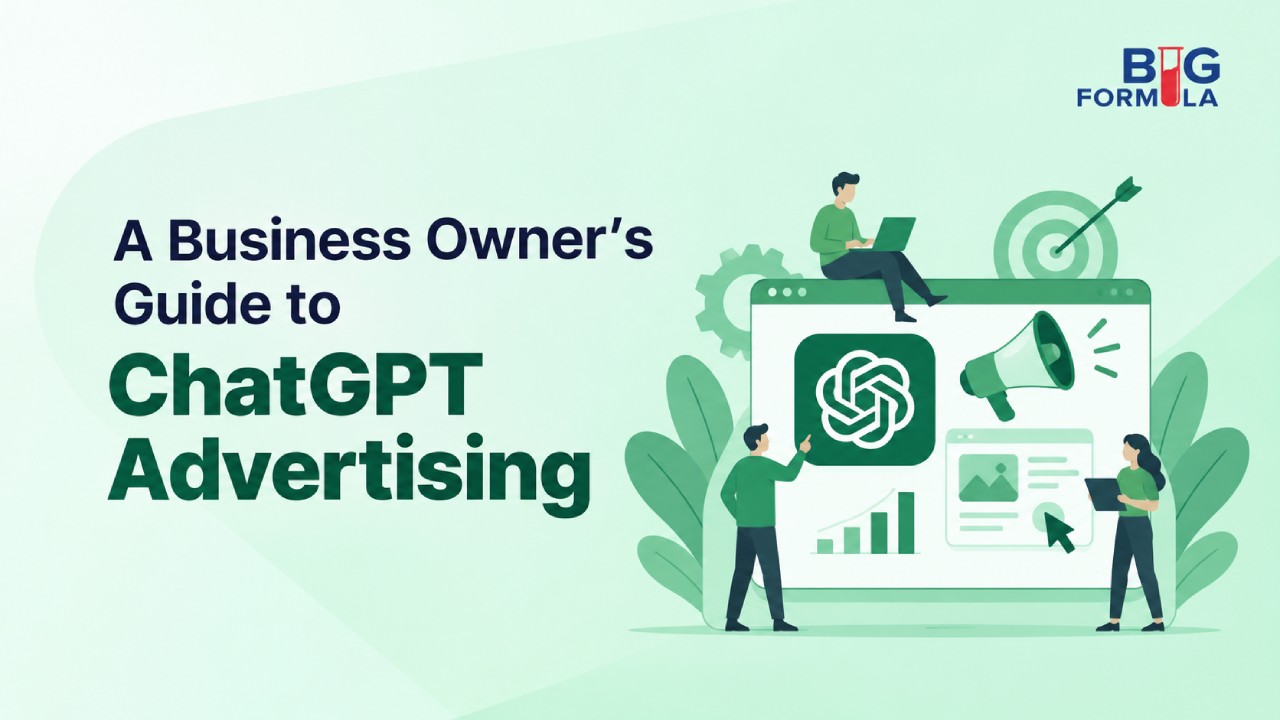
A Business Owner’s Guide to ChatGPT Advertising
No keywords. No match types. No published benchmarks. ChatGPT advertising is a new kind of channel, and this guide shows how to test it while staying in your budget.
-
 By
Anjna Raj
|
- • 17 min Read
A textile retailer in Surat who runs Google Ads would be forgiven for assuming ChatGPT advertising works the same way: choose keywords, set bids, collect clicks. It does not. A shopper in Pune asks ChatGPT for a Chanderi saree under ₹5,000 that will arrive before Diwali, refines the request over several messages and then sees a labelled sponsored card below the answer. Nobody typed a keyword, and the click, if it comes, may arrive minutes later. Treating this channel as search with a new logo is the quickest way to waste an ad budget.
ChatGPT Advertising Works on Conversations, Not Keywords
ChatGPT advertising works differently from traditional search advertising. Rather than targeting specific search queries, ads are matched to the context and intent of a conversation. Advertisers provide contextual signals that indicate where their ads are most relevant, rather than bidding on keywords. Ads appear in clearly labelled placements separate from the AI-generated response and are currently shown only to users on the Free and Go plans. OpenAI also states that user conversations are not shared with advertisers.
Success metrics differ as well. Unlike search, where clicks are often a strong indicator of intent, ChatGPT users frequently engage in longer decision-making or problem-solving journeys. As a result, an ad impression may influence an action even when no click occurs. OpenAI reports that, in an early analysis of global campaigns, 52.7% of eligible one-day view-through conversations took place within an hour of the matched ad impression, suggesting that purchasing decisions can be influenced directly by exposure to the ad. At the same time, advertisers should recognise that the channel remains in its infancy. Ads Manager entered beta on 5 May 2026, and OpenAI reported reaching 100,000 advertisers by 21 October. Expectations, benchmarks, and investment decisions should therefore be framed with the platform’s relative immaturity in mind.
In practice, that means no keyword lists, no match types and no expectation that search habits transfer. Budgets, hints, creative and landing pages do the work that keyword research does elsewhere, and the person seeing the ad is mid-conversation rather than mid-search.
Seven Steps to Launch a First Campaign
1. Confirm eligibility and pick one goal
Advertising with ChatGPT is not yet available in every market. India was among the countries included in an earlier rollout phase, gaining access ahead of OpenAI’s more recent expansion to 89 additional markets. Before launching a campaign, identify one primary goal, whether that’s generating enquiries, securing bookings, or driving purchases. A clear objective makes campaign setup, measurement, and optimisation far more effective.
2. Build the landing page and tracking first
Install the OpenAI Pixel, the Conversions API, or both. OpenAI requires conversion tracking before a campaign can optimise for conversions.
3. Create and verify the account
Sign in at ads.openai.com with a work email, add a logo, set up billing and complete verification.
4. Choose the objective and budget
Options include impressions, clicks and conversion optimisation. The last one works on one standard event per campaign, such as a purchase, sign-up or lead, and that event cannot be changed after creation. The minimum daily budget listed for India is ₹725.
5. Write context hints
Give each ad group one intent, phrased as a real customer question: eggless birthday cake in Chennai on the same day, or a GST filing accountant for a new boutique in Ahmedabad.
6. Write the ad
Add a title, description, image and a landing page URL that repeats the promise in the hint.
7. Review weekly, then graduate
Allow data to accumulate before editing. Once conversion events are flowing reliably, test the conversion optimisation objective against clicks.
Benefits Specific to Small Businesses
- The first benefit is stated intent. A shopper who has spent four messages specifying budget, fabric and delivery date arrives with a better-defined need than a person typing three words into a search bar.
- The second is new-customer reach. In an OpenAI update on the platform’s growth, a technology partner reported that more than 80% of ad-driven ChatGPT traffic came from new customers. For a Jaipur jewellery label with a loyal repeat base, that matters more than raw click volume.
- The third is a low entry price. A 28-day test at ₹725 a day totals ₹20,300 in nominal budget, which is within reach of a single-shop business that has worked out what a customer is worth.
- The fourth is measurement beyond the last click. An independent geo-lift study by WorkMagic estimated 2.3x more incremental orders for the wellness brand Dose than last-click attribution captured, according to OpenAI’s October 2026 measurement update. For a channel where impressions can influence purchases without clicks, that kind of evidence helps small advertisers avoid cancelling a campaign that is working.
- The fifth is simplicity. Ads Manager keeps budgets, ad groups, creative and reporting in one portal, so a founder can run a first test without an agency, which keeps the early cost of learning small.
What the Conversion Data Shows and What it Does Not Show
OpenAI has published no average conversion rate for ChatGPT ads. Its Help Centre states that, as an early platform, ChatGPT Ads does not yet have performance benchmarks across advertisers, industries or campaign types. Any article quoting an industry-wide figure is therefore quoting a projection.
What exists is a small set of partner results. OpenAI reported that DV Rockerbox measured WeightWatchers’ attributed cost per acquisition on ChatGPT Ads at 15.3% below its blended paid search benchmark. OpenAI also cited an ecommerce advertiser that achieved a 3x return on ad spend across its campaigns over 28 days. One agency published 15 days of live spend from a single account: roughly $60,000 in spend, about $89,000 in revenue, a 1.49x blended return and a 2.35% conversion rate.
These are individual cases selected for publication, and the agency figure comes from one advertiser. They show that conversion is achievable but it may be not what a Coimbatore tuition centre should expect. The sound benchmark is the owner’s own: cost per enquiry measured against what an enrolled student is worth.
A simple equation comes handy here. If a Coimbatore tuition centre earns ₹3,000 from each enrolled student and converts one enquiry in ten into an enrolment, each enquiry is worth about ₹300 in revenue. A cost per enquiry above that figure loses money before costs, whatever any published benchmark says.
Search Habits That Damage ChatGPT Campaigns
Three habits carry over from search and cause trouble.
- The first is judging a campaign by clicks alone, when OpenAI’s own data shows conversions arriving after impressions without a click.
- The second is choosing a weak optimisation event: conversion optimisation pursues whatever event is selected, so a Kochi spice exporter should optimise toward enquiry submissions, not page views. OpenAI’s Help Centre also warns that choosing clicks as the delivery basis for a conversion optimisation campaign lowers conversions.
- The third is sending every ad group to one page, which breaks the continuity between question and answer.
The Landing Page Turns a Conversation Into a Conversion
Everything before the click is borrowed attention. A visitor who asked about eggless birthday cakes in Chennai has already refined the request through several questions, so a bakery’s general homepage forces the visitor to start again. A converting page continues the conversation: it repeats the promise in the ad, shows eggless cakes, a same-day delivery slot and a payment option, and loads quickly on a mid-range phone. Each ad group needs its own page because each targets a different intent.
That is where BIGFORMULA’s UX/UI design services and custom web development earn their place with intent-matched pages built to convert paid visits into enquiries, bookings or sales rather than anonymous traffic.
Tracking is the other half. Conversion optimisation can only steer toward events it can see, and OpenAI’s Conversions API sends first-party data from an advertiser’s own systems straight back to the platform. For owners without in-house developers, a technology partner such as BIGFORMULA, with teams in India and the UAE, can build the page and the tracking together so that the first week of spend produces usable evidence.
Frequently Asked Questions
1. What starting bid does OpenAI suggest?
OpenAI’s guidance suggests a starting maximum cost per click of $3 to $5. That figure is a starting point for bidding, not a published price list or an observed average.
2. How quickly do reports update?
Impressions and clicks refresh roughly every 15 minutes, while spend can lag by seven to eight hours. A displayed $0 beside live clicks does not mean nothing has been charged.
3. What is Event Quality Score?
Event Quality Score is an OpenAI tool that helps advertisers assess the quality of the signals sent through the Pixel and Conversions API. Its purpose is to highlight where tracking can be improved, giving optimisation better information.
4. Can conversion data come from tools a business already uses?
Yes. OpenAI announced integrations with Hightouch, Tealium and LiveRamp in October 2026, which make it easier to send conversion data from existing systems to ChatGPT Ads.
Conclusion
ChatGPT advertising rewards the opposite habits to Google Ads: fewer assumptions about clicks, more attention to what happens afterwards. The entry price is modest and the early partner results are encouraging, but no official benchmark exists, so every small business is effectively writing its own. For an Indian business, a ₹20,300 test is the price of finding out whether conversations about its category are happening in ChatGPT at all. Build the page and the tracking first, then the campaign. And when in doubt, Talk to BIGFORMULA.
Sources
OpenAI Ads, More ways to measure ChatGPT Ads (October 2026)
OpenAI, A milestone in expanding access to AI
OpenAI Help Centre, Conversion-optimized campaigns
OpenAI Help Centre, Create Campaigns for ChatGPT and Quickstart
TechCrunch, ChatGPT ads in India
Opascope, ChatGPT Ads benchmarks from 15 days of real spend (single-account agency report)